

You didn’t expect the pain to last this long. After the accident, you were told it was probably just a strain. But weeks later, the sharp jolts in your back, the numbness in your legs, and the stiffness every time you move tell a different story. The MRI confirmed it — a herniated disc. And suddenly, everything changes.
You’re not just dealing with discomfort — you’re navigating a new reality filled with doctor visits, medical bills, missed work, and constant uncertainty. Will you recover fully? Will the pain ever stop? And who’s going to pay for all of this?
If your injury was caused by a car accident, you may be entitled to compensation, but not all herniated disc cases are treated equally. In Texas, settlement amounts can vary widely depending on the severity of your condition, including instances of severe pain, how clearly fault is proven, and whether your ongoing needs are properly documented and valued.
In this blog, we’ll break down what goes into a herniated disc settlement — from the medical side to the legal strategy — and help you understand what a fair recovery might actually look like. Because this isn’t just about back pain. It’s about reclaiming control over your life.
What Is a Herniated Disc and Why Does It Matter After a Car Accident?
A herniated disc isn’t just a medical term — it’s an injury that can change how you move, work, sleep, and function every day. After a car accident, even a low-speed collision, the force can compress or twist the spine, causing the soft center of a disc to push out and press on nearby nerves in the spinal cord. That pressure creates pain — sometimes constant, sometimes shooting down your limbs — and can limit your ability to walk, lift, or even sit without discomfort.
For many accident victims, a herniated disc becomes the start of a long recovery journey involving physical therapy, pain management, and sometimes surgery. It’s also one of the more common reasons injury claims escalate, given how disruptive this condition can be to daily life and earning capacity.
Understanding the Mechanics: What Actually Happens to Your Spine?
Inside your spine are rubbery spinal discs that act as cushions between your vertebrae. When a disc herniates, the inner gel-like core, known as the nucleus pulposus, slips through a tear in the tough outer layer, kind of like toothpaste squeezing out. If it touches or compresses a nerve, it causes inflammation, pain, numbness, or weakness in the area the nerve controls.
- Lumbar (L4-L5, L5-S1) disc herniations affect the lower back and legs.
- Cervical (C4-C5, C5-C6) herniations affect the neck, shoulders, and arms.
Car accidents often cause this kind of trauma through rapid flexion/extension (whiplash), seatbelt pressure, or spine compression from impact.
Key Symptoms That Signal a Herniated Disc
After a crash, back or neck soreness may seem minor at first, but if it evolves into any of these symptoms, a herniated disc may be the cause:
- Sharp or burning pain in your lower back, neck, or between your shoulders
- Pain radiating down your leg (sciatica) or arm
- Tingling, numbness, or pins-and-needles in extremities
- Muscle weakness or loss of coordination
- Trouble standing, sitting, or walking for extended periods
These symptoms may not appear immediately. Many victims only realize something is seriously wrong days or weeks after the accident. That’s why early documentation and follow-up care matter — both for your recovery and for building a strong claim.
How Herniated Discs Are Diagnosed (and Why It Affects Your Settlement)?
A clinical exam alone isn’t enough to confirm a herniated disc — objective testing is required. This usually includes:
- MRI scans: Most accurate for viewing soft tissue and nerve impingement
- CT scans: Helpful when MRI isn’t available or conclusive
- Neurological testing: Confirms how the injury is affecting movement, sensation, and function
For legal purposes, this diagnostic proof is non-negotiable. If your MRI confirms a disc pressing on a nerve root, it validates both the seriousness of your injury and the legitimacy of treatment needs, which insurers use to estimate your settlement value.
What Drives the Value of a Herniated Disc Settlement?
No two herniated disc cases are the same. Even with similar diagnoses, settlement amounts can vary widely. Why? Compensation depends not just on the injury and the severity of the injury but also on how it affects your life, your income, and your recovery journey.
Here are the key factors that shape the value of your claim:
1. How Severe the Injury Is
Mild disc injuries that respond to rest or physical therapy generally lead to lower settlements. But when the herniation causes chronic pain, nerve damage, or requires fusion surgery, the value of your claim increases — sometimes significantly.
If your condition limits your mobility or requires ongoing care, these long-term effects need to be clearly documented to support full compensation.
2. How the Injury Affects Your Daily Life
Can you still work, drive, exercise, or care for your family the same way you did before the accident? If not, that disruption matters. The greater the impact on your independence and quality of life, the more your non-economic damages, like pain and suffering, will factor into your settlement.
Evidence like doctor’s notes, personal journals, and testimony from family or coworkers can help demonstrate these limitations.
3. Lost Wages and Reduced Earning Potential
If your injury kept you off the job — or forced you to take a lower-paying or less demanding role — you can seek compensation for both immediate income loss and long-term earning capacity.
Clear proof of lost income (pay stubs, employer statements, tax returns) strengthens this part of your claim. In some cases, a vocational expert may be needed to project how your injury will affect future employment.
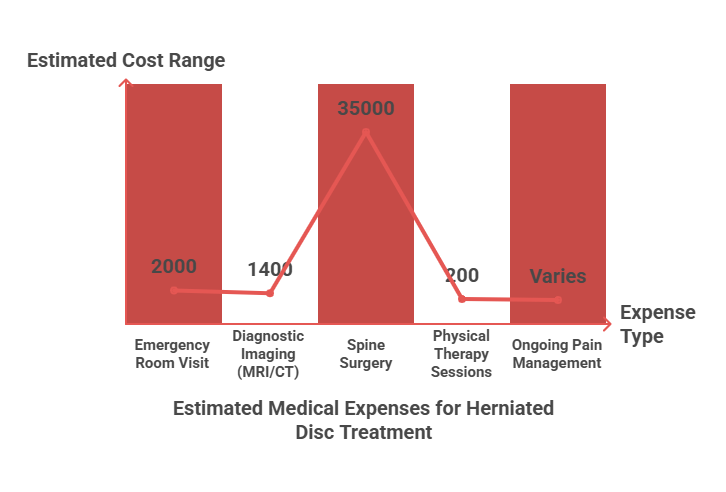
4. The Full Cost of Your Medical Treatment
Medical bills are the backbone of most personal injury claims. Your settlement should reflect both what you’ve already spent and what you’re likely to spend moving forward.
| Expense Type | Estimated Range |
|---|---|
| Emergency Room Visit | $1,000 – $3,000 |
| Diagnostic Imaging (MRI/CT) | $800 – $2,000 |
| Spine Surgery | $20,000 – $50,000+ |
| Physical Therapy Sessions | $50 – $350 per session |
| Ongoing Pain Management | Varies by treatment plan |
If your care will continue for months or years, due to persistent symptoms or surgical recovery, those projected costs must be backed by strong medical documentation.
How Texas Law Impacts Your Herniated Disc Settlement

If you’re pursuing a herniated disc settlement after a car accident in Texas, state law plays a major role in determining how much you can recover — and how your claim is handled by a car accident lawyer at a personal injury law firm.
From fault rules to insurance limits, these legal factors can strengthen or weaken your case depending on how they’re managed.
Here’s what you need to know.
1. What Happens If You’re Partly at Fault?
Texas follows a 51% modified comparative fault rule. You can still receive compensation even if you’re partially at fault — but only if you’re found less than 51% responsible. Your payout is then reduced by your percentage of fault.
Example: A $100,000 award becomes $80,000 if you’re 20% at fault.
Because accident fault responsibility directly impacts how much you receive, it’s critical to preserve evidence like accident scene photos, dashcam footage, and witness statements to limit your exposure and support your claim.
2. The Deadline That Can Cancel Your Claim
In Texas, you have two years from the date of the accident to file a personal injury lawsuit. Miss this window, and your right to compensation is gone — no matter how valid your case is.
Starting the process early gives your legal team time to collect medical records, secure expert opinions, and preserve witness testimony — all of which are critical in herniated disc cases where long-term impact is a major factor.
3. When Insurance Isn’t Enough
Texas law requires all drivers to carry 30/60/25 liability coverage:
- $30,000 for bodily injury per person
- $60,000 total per accident
- $25,000 for property damage
But spinal injuries like herniated discs — especially those requiring surgery — often result in costs that far exceed these limits.
That’s where Uninsured/Underinsured Motorist (UM/UIM) coverage becomes essential. It helps cover the gap when the at-fault driver’s policy doesn’t come close to covering your actual medical costs, lost wages, and future care needs.
4. Can Texas Limit Your Compensation?
There are no caps on economic or non-economic damages in most Texas car accident cases. That means you can be fully compensated for:
- Medical bills
- Lost income
- Pain and suffering
- Loss of enjoyment of life
However, if your case involves gross negligence or reckless behavior (like a DWI crash), you may also qualify for punitive damages. These are capped at:
- $200,000, or
- 2x economic damages + up to $750,000 in non-economic damages
Punitive damages are rare but can significantly boost total recovery in high-severity cases.
5. Why the Police Report Is More Important Than You Think
Texas law requires a police report for any accident involving injuries or over $1,000 in property damage. This report is foundational to your claim, especially when symptoms from a herniated disc emerge days or weeks later.
It provides:
- Third-party documentation of the incident
- Initial fault assessment
- Officer notes, weather/road conditions, and citations issued
This early documentation can help counter arguments from insurers that your injury wasn’t caused by the crash.
6. Your Medical Records = Your Case Value
Strong, continuous medical documentation is critical in any herniated disc settlement. Without it, insurers may argue that your injury is unrelated, exaggerated, or pre-existing.
Your records should include:
- MRI or CT imaging results
- Diagnosis and prognosis from your treating physician
- Physical therapy notes
- Pain management plans
- All receipts and billing documents
This evidence helps calculate both past expenses and projected future costs, which together form the financial foundation of your settlement.
What are the Estimated Settlements by Injury Type?

Here’s a closer look at average settlement ranges based on specific types of herniated disc injuries often seen in car accident claims.
1. Discectomy Settlement
Estimated Range: $50,000 – $150,000
A discectomy is a common surgical procedure to relieve nerve compression. The settlement typically reflects the cost of surgery, rehab, and recovery time. Outcomes — and compensation — depend on how well the patient heals and whether complications arise.
2. C4–C5 Cervical Disc Injury
Estimated Range: $75,000 – $250,000
This neck-level herniation can cause pain, reduced mobility, and arm weakness. Higher settlements account for extended treatment, limited function, and disruption to work or daily life.
3. Herniated Disc with Pinched Nerve
Estimated Range: $100,000 – $350,000
A disc pressing on a nerve root often leads to intense pain, sciatica, and sometimes surgery. These injuries typically require more aggressive treatment and longer recovery periods — factors that increase claim value.
4. Herniated Disc Without Surgery
Estimated Range: $30,000 – $100,000. Some injuries respond to non-surgical treatment like physical therapy, including months of physical therapy or injections. These settlements are lower but still reflect lost time at work, medical bills, and lingering symptoms.
5. Three Herniated Discs
Estimated Range: $150,000 – $500,000
Multiple herniations raise the stakes significantly. Recovery is longer, medical costs are higher, and the impact on quality of life is often more severe — all of which contribute to a larger payout.
6. L5–S1 Herniated Disc
Estimated Range: $50,000 – $200,000. Located in the lumbar spine, L5–S1 injuries often cause lower back pain and radiating leg symptoms. They are among the most common herniated disc injuries in auto accidents and frequently affect a person’s ability to work or stay active.
7. Four Herniated Discs
Estimated Range: $200,000 – $600,000. Severe, multi-level herniations often require surgery and long-term therapy, leading to potential future medical expenses. The severity of the injuries can result in permanent disability, lifestyle changes, and substantial loss of earning capacity — which all push the settlement higher.
Tired of Adjusters Undervaluing Your Pain? Titanium Law Firm Changes That
Insurance companies have one goal: close your claim for as little as possible. And with herniated disc injuries — where the pain is real but hard to “see” — they exploit every gray area. They question your MRI, downplay your symptoms, and pressure you to settle before you even understand the long-term impact.
At Titanium Law Firm, we don’t let that slide.
We’ve handled complex spinal injury cases across Texas and know exactly how to prove the full scope of your pain — from delayed symptoms and nerve damage to lost wages and future care needs. Our attorneys build medically supported cases that force insurers to pay attention — and pay what’s fair.
While you focus on healing, we’ll handle the fight. Contact Titanium Law for your next step.
Conclusion
This blog provides a comprehensive view of herniated disc settlements associated with car accidents, focusing specifically on the state of Texas. We’ve explored factors that impact the settlement amount, including the severity of your injury, who was at fault, and implications on your daily life.
Moreover, we’ve unpacked specific types of herniated disc injuries and the average settlement for each. While providing a useful yardstick, remember that these figures should be taken as averages and not predictive of any individual case.
Every herniated disc injury case is unique, with varying degrees of physical pain, restrictions, and long-term complications that must be accurately valued. It is vital to consult with an experienced personal injury lawyer who can navigate your claim and maximize your recovery effectively.
Frequently Asked Questions
1. What is the typical timeline for settling a herniated disc case?
The timeline for a herniated disc from car accident settlement can vary significantly. On average, it ranges from a few months to two years. Simpler cases — especially those involving a bulging disc or short-term treatment — may settle quicker. However, severe cases requiring surgery, multiple parties, or litigation may take much longer to resolve.
2. Can pre-existing back issues affect my settlement outcome?
Yes. If you had a prior back condition — such as a cervical spine injury or prior neck pain — insurance companies may argue your current symptoms aren’t accident-related. However, under Texas’s “eggshell skull” rule, if a car crash worsens your pre-existing issue, you’re still eligible for compensation through a car accident herniated disc settlement. Strong medical records help establish this link.
3. How do I prove the car accident caused my herniated disc?
To prove your herniated disc injury is tied to a crash, you’ll need prompt medical care including diagnostic imaging like MRIs or CT scans. Documentation is key to validating a herniated disc claim. Supporting evidence — like police reports, insurance coverage details, and expert medical testimony — helps establish that the accident caused or aggravated the disc injury, especially for cervical or lumbar spine cases.
4. What if multiple parties are at fault in the accident?
In Texas, liability is split based on fault percentage. If several drivers share blame, each is responsible for their share of damages. An experienced personal injury attorney can help identify all liable parties and negotiate a stronger hernia car accident settlement or herniated disc car accident settlement, especially when medical expenses are high or income loss is long-term.
5. Should I accept the first settlement offer from insurance?
Rarely. The first offer from insurers is often low — especially for claims involving a herniated disc in neck car accident settlement or steroid injections. Insurance adjusters may not account for ongoing therapy, lost income, or pain and suffering. Always consult with an attorney for legal advice before accepting. They can ensure the offer reflects the average settlement for herniated disc car accident injuries in similar cases.
6. How can an attorney help increase my settlement amount?
A qualified attorney builds a strategic case by documenting injuries, proving fault, and presenting long-term costs clearly — especially for complex claims like settlement for herniated disc in a car accident or multi-disc injuries. They handle all communications, assess whether you’re under-compensated, and take the case to trial if needed. Legal support often results in significantly higher payouts, especially for cervical spine or how much is 2 herniated disc settlement cases.