

You didn’t think a crash would leave you struggling to remember basic tasks, battling brain fog, or missing weeks of work. But here you are—stuck in doctors’ offices, drowning in medical bills, and still feeling off.
A concussion isn’t just a bump on the head—it’s a brain injury. And if you’re dealing with one, you deserve a settlement that reflects the full impact.
This blog breaks down how these claims are valued, what factors drive payout amounts, and how to protect your case from being undervalued.
What Happens When You Get a Concussion from a Car Accident?
In a car accident, your brain can be jolted or struck due to a sudden impact, which leads to a concussion—essentially a mild traumatic brain injury (TBI) in many auto accident lawsuits. This happens when your brain shifts within your skull, causing temporary disruptions in brain function. Even if you don’t hit your head directly, the whiplash motion from the crash can also cause the rapid movement of the head, resulting in a concussion.
Understanding the physical effects is important, but knowing what to do after a car accident in Texas can be just as critical to your case.
Don’t Dismiss These Concussion Symptoms—Even If They’re Delayed
The tricky thing about concussions is that the concussion symptoms, including the duration of symptoms, might not show up right away. They can take hours or even days to develop. Here are some common signs to watch for:
- Headaches: Almost everyone with a concussion experiences some form of headache.
- Loss of Consciousness: If the concussion is more severe, you might temporarily lose consciousness, though this doesn’t happen in every case.
- Mental Fog: Difficulty concentrating or feeling mentally “off” can be signs that something’s wrong.
- Memory Loss: It’s not uncommon to forget the details of the accident, or even the moments leading up to it.
- Sensitivity to Light or Noise: A sudden sensitivity to bright lights or loud sounds could indicate a concussion.
Since symptoms can take days to emerge, many people wonder when it’s too late to hire a lawyer for a car accident. Find out on our blog here.
4 Factors That Impact Concussion Settlement Values After a Car Accident

Concussion settlements hinge on measurable factors: clinical severity, the severity of symptoms, long-term medical outcomes, wage loss, and psychological impact. In Texas, legal standards and documentation thresholds also shape payout values for a personal injury claim, potentially resulting in larger settlements.
Each of these elements plays a role in how car accident settlements are calculated in Texas.
1. Concussion Severity and Medical Evidence
Settlement value increases with the documented severity of the concussion. A mild case with short-term symptoms will yield less than one involving prolonged unconsciousness, cognitive impairment, or positive findings on CT or MRI scans, which plays a significant role in the settlement value.
Solid medical evidence is non-negotiable. Neuro evaluations, imaging, and physician records must clearly link the concussion to functional limitations. Without that, insurers minimize payouts or deny claims outright.
2. Post-Concussion Syndrome (PCS)
PCS complicates recovery — and increases settlement value. Persistent symptoms like memory loss, concentration issues, and dizziness signal ongoing neurological disruption.
Insurers require more than self-reported symptoms. Longitudinal records, neuropsychological testing, and expert witness input are essential. PCS proves that the injury didn’t end at the ER visit — it affects your daily capacity, possibly for years.
3. Lost Wages and Future Earning Capacity
Concussions often force missed work or career shifts. Claims should account for both immediate lost wages and long-term earning reductions, especially if the cognitive demands of your job are no longer manageable.
| Duration Off Work | Wage Rate | Loss Estimate |
|---|---|---|
| 4 weeks @ $20/hr | $20/hr | $3,200 |
| 6 months @ $40K/yr | $40,000/year | $20,000+ |
| Long-term work limits | Variable | High impact |
A vocational assessment may be necessary to validate diminished earning potential. Without it, future income losses are speculative — and likely dismissed.
4. Psychological Trauma
Concussions frequently trigger PTSD, anxiety, or depressive disorders, especially post-collision. This emotional fallout isn’t secondary — it’s compensable.
However, emotional distress claims must be clinically backed. Diagnoses from licensed professionals, treatment logs, and DSM-5 references are critical. Without proof, emotional damages are undervalued or ignored during negotiations.
How Texas Law Shapes the Value of Your Concussion Claim?
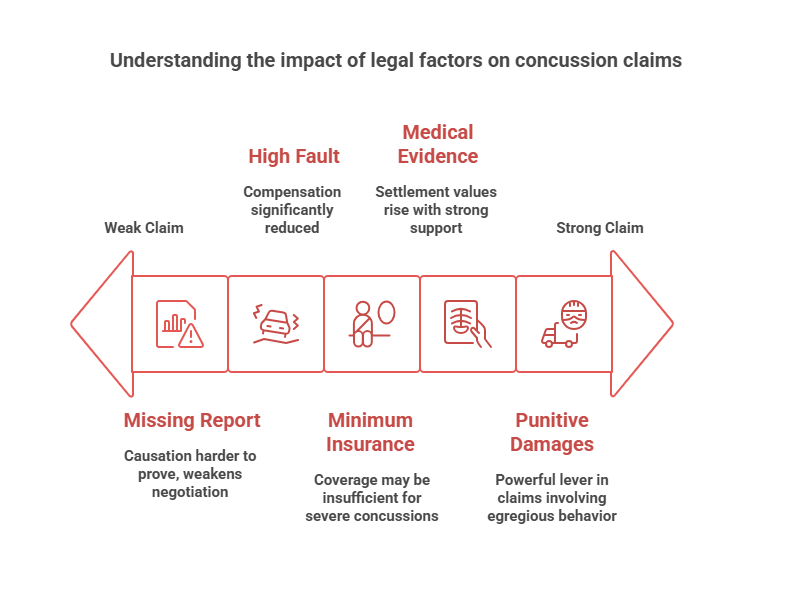 In Texas, state law doesn’t just influence how much you can claim — it sets legal boundaries that determine whether your concussion case moves forward, how liability is divided, and how much compensation you’re ultimately entitled to. These are the key legal factors that directly impact concussion settlement outcomes:
1. Modified Comparative Fault
Texas applies a 51% modified comparative fault rule. You can only recover damages if you’re 50% or less at fault for the crash. Your compensation is reduced in proportion to your degree of fault.
Example: If you’re 20% at fault, a $100,000 settlement is reduced to $80,000.
Clear liability matters. Evidence such as dashcam footage, accident reconstruction, and third-party witness statements are critical to minimizing your fault percentage and maximizing payout.
2. Statute of Limitations: 2 Years
You have two years from the date of the accident to file a personal injury lawsuit in Texas. Missing this deadline bars you from recovering any compensation — no exceptions.
Early action is strategic. Over time, medical records become incomplete, witnesses disappear, and insurer leverage increases. Prompt legal filing preserves claim integrity and improves negotiating power.
3. Minimum Liability Insurance Requirements
Texas requires drivers to carry at least:
- $30,000 for injury per person
- $60,000 per accident total
- $25,000 for property damage
For moderate to severe concussions, these minimums are often insufficient. If the at-fault driver is underinsured or uninsured, UM/UIM coverage on your own policy becomes critical. It can bridge the gap, especially in high-cost cases involving long-term care or post-concussion syndrome.
4. Punitive Damages Cap
Texas allows punitive damages in cases of gross negligence or intentional harm (e.g., DUI, reckless driving). These are awarded in addition to economic and non-economic damages, including insurance coverage for related expenses.
The cap:
- $200,000, or
- 2x economic damages + up to $750,000 in non-economic damages — whichever is greater.
While not common in all cases, they’re a powerful lever in claims involving egregious behavior.
5. Police Report Requirements
A police report is legally required if:
- There are injuries, or
- Property damage exceeds $1,000
6. Weight of Medical Evidence in Texas Courts
Texas law doesn’t mandate specific medical documentation — but insurers and courts heavily prioritize it when evaluating injury claims. Settlement values rise when claims are supported by:
- ER records
- Imaging results (CT, MRI)
- Neurology evaluations
- Longitudinal treatment notes
- Prognostic reports
Texas has clear rules on fault and liability—and in severe cases, drivers may even face criminal charges. Learn more about whether you can go to jail for a car accident in Texas here.
How to Prove an “Invisible Injury” to an Insurance Company?

Concussions are often invisible injuries, with no broken bones, bruises, or dramatic X-rays. That makes proof the core challenge in legal claims.
Without concrete evidence, insurers or opposing counsel will argue your symptoms are exaggerated or unrelated to the crash. To build a defensible and high-value claim, each element below must be treated as a critical part of your case file.
1. Medical Records and Objective Diagnostics
Concussion claims stand or fall on medical documentation. The following are essential:
- Neurological assessments to confirm functional impairment
- CT scans or MRIs to rule out other injuries and support diagnosis
- Ongoing clinical records showing symptom persistence over time
2. Expert Testimony: Neurologists & Neuropsychologists
Lay testimony alone is weak in concussion claims. You need expert witnesses who can:
- Interpret complex test results
- Explain long-term prognosis and impact on cognitive function
- Validate PCS (post-concussion syndrome) symptoms as medically credible
3. Insurance Negotiation Strategy
Insurers are trained to minimize payouts. For concussion claims, expect them to:
- Downplay symptoms as “subjective”
- Blame symptoms on pre-existing conditions or stress
- Push for early, undervalued settlements
4. Documentation: Precision and Consistency
Documentation must be exhaustive and meticulously organized. At minimum, include:
- All imaging and neurological test results
- Physician notes and treatment plans
- Symptom journals (dates, descriptions, impact on daily tasks)
- Proof of wage loss (pay stubs, employer letters)
- Out-of-pocket expenses (medications, therapy, transportation)
Typical Concussion Settlement Amounts in Car Accident Cases
Concussion settlements vary widely — and for good reason. Unlike visible injuries, traumatic brain injuries (TBIs) like concussions affect cognitive, emotional, and functional abilities in ways that are harder to quantify, including the risk of traumatic stress. The severity of the injury and settlement values depend heavily on diagnosed severity, symptom duration, and the potential for higher compensation based on the long-term impact on your work and daily life.
1. Mild vs. Severe Concussions: Value Benchmarks
Settlement figures tend to correlate directly with clinical severity, influenced by various factors. While no two cases are identical, this breakdown reflects common compensation ranges seen in Texas and nationwide:
| Injury Severity | Estimated Settlement Range |
|---|---|
| Mild Concussion | $20,000 – $30,000 |
| Moderate–Severe Concussion | $50,000 – $80,000+ |
These estimates assume established medical documentation, documented time off work, and symptom persistence. Severe cases with post-concussion syndrome (PCS) or permanent cognitive limitations may exceed $100,000, particularly when future medical care or diminished earning capacity is provable.
2. Variables That Push Settlement Values Higher
Several technical and evidentiary factors can raise your claim’s value:
- Documented neurological deficits (memory loss, concentration issues)
- PCS diagnosis with consistent treatment records
- High medical expenses and long recovery timelines
- Loss of earning capacity or career disruption
- Expert testimony validating long-term impact
Without this level of documentation, insurers will default to the lower end of the settlement range or attempt to discredit your symptoms altogether.
3 Challenges in Pursuing a Post-Concussion Syndrome Settlement

Securing compensation for post-concussion syndrome (PCS) after a car crash involves unique legal and evidentiary hurdles. Unlike broken bones, PCS often lacks visible symptoms, making it easy for insurers to question, minimize, or outright deny your claim. To succeed, your case must be built around objective medical data, expert validation, and a clear timeline linking symptoms, including the risk of permanent brain damage, to the crash.
1. Disputes with Insurance Companies
Insurance adjusters routinely downplay PCS claims, especially when symptoms are subjective or extend beyond the “typical” recovery window. They may argue:
- Your symptoms stem from pre-existing conditions
- Your diagnosis lacks objective medical proof
- Your injury is exaggerated or not accident-related
2. Delayed Onset of Symptoms
PCS symptoms often emerge days or weeks post-accident—well after you’ve walked away from the scene. These may include the following:
- Cognitive fog
- Mood swings
- Persistent headaches
- Sensory sensitivity
3. Difficulty Proving an “Invisible” Injury
Concussions and PCS lack external markers, making them hard to visualize—and therefore, to validate in court or settlement talks. That’s why diagnostic imaging (when available), neurological test results, and functional assessments are crucial. They do the following:
- Provide measurable proof of brain trauma
- Establish medical necessity for treatment
- Support projected long-term costs and disability
Do You Need a Personal Injury Attorney for a PCS Settlement?
Deciding to go through a post-concussion syndrome (PCS) claim without legal representation can be risky. A skilled personal injury attorney brings the expertise needed to manage insurance tactics, offer legal advice, build a strong evidentiary case, and secure a free case evaluation to ensure the full value of your claim.
Strategic Advantages
- Claims management: Attorneys handle all communications with insurers, preventing costly missteps and lowball offers.
- Evidence gathering: They coordinate with medical professionals to obtain diagnostic tests, expert testimony, and documentation linking your PCS to the crash.
- Case valuation: A good attorney knows how to quantify both economic and non-economic damages—including long-term care, lost income, and cognitive impairment.
- Litigation readiness: If negotiations stall, your attorney can escalate the case to trial with a clear legal strategy and compelling evidence.
Firms like Titanium Law are especially equipped to handle medically complex, hard-to-prove claims like PCS — ensuring clients don’t get dismissed or lowballed due to “invisible injuries.”
How Titanium Law Helps PCS Clients Reclaim Stability and Control?
For many concussion victims, the hardest part isn’t the injury — it’s the aftermath. You’re missing work, your memory is unreliable, your anxiety is peaking, and every task feels twice as hard. And while you look “fine” on the outside, you know things aren’t okay.
Titanium Law changes this.
We don’t rely on assumptions — we build claims on measurable facts, long-term impact, and deep medical coordination. Our team:
- Works closely with neurologists, cognitive specialists, and therapists to build objective proof of PCS
- Quantifies how your symptoms limit your earning ability, not just now, but in the future
- Anchors every claim in Texas-specific legal frameworks — including comparative fault, insurance minimums, and statutory deadlines
- Maintains momentum — no drawn-out lulls, no passive negotiations, just focused, strategic advocacy from day one
We understand that PCS isn’t just about getting better — it’s about rebuilding stability, mentally, physically, and financially. And we treat every case with the urgency and depth it deserves.
Find out what your concussion claim is really worth — not just what the insurer says. Request a free consultation here.
Conclusion
A concussion from a car accident doesn’t just disrupt your day—it disrupts your entire life. The constant headaches, the brain fog, the emotional toll—it’s all-consuming. And the longer it lingers, the harder it becomes to move forward. But here’s the truth: your car accident concussion settlement shouldn’t just cover ER bills; it should reflect the lasting impact on your work, mental health, and daily function.
Whether you’re pursuing a settlement for concussion in car accident claims or navigating the complex aftermath of post-concussion syndrome, the potential compensation value of your case depends on how clearly you document your losses and present your case.
The process may seem complex, but each detail of your injury—from lost wages to emotional distress—matters for obtaining fair compensation. Don’t leave it to chance. Gather the right documentation, work with the right experts, and make sure your concussion car accident settlement amount fully reflects the damage done.
This isn’t just about compensating for pain; it’s about restoring stability and giving you a way forward—free from the financial weight of an injury that refuses to fade.
Take control. Your car accident settlement for concussion should match the true cost of your recovery. You deserve nothing less.
Frequently Asked Questions
How does the severity of a concussion influence the settlement amount?
The severity of a concussion directly affects your concussion settlement car accident value. More serious injuries — like those involving unconsciousness or long-term PCS — often lead to higher payouts due to intensive medical costs, extended time off work, and ongoing cognitive issues. This directly influences your car accident concussion settlement amount.
Why is prompt medical attention crucial after a car accident?
Early medical evaluation by medical experts is essential not just for your health, but also for supporting a strong car accident settlement concussion claim. It provides a clear timeline and diagnostic record, both of which are crucial for proving that your concussion is directly linked to the crash.
What is the importance of medical documentation for proving concussion injuries?
When pursuing a concussion diagnosis from car accident settlement, documentation is everything. Physician notes, imaging results, and neurological evaluations form the foundation of your case. They link your diagnosis to the accident and help determine the average settlement for concussion car accident cases with similar injuries.
Why should you consider hiring a personal injury attorney for your concussion claim?
Legal representation dramatically increases your chances of securing a fair concussion car accident settlement amount. Experienced attorneys understand how to translate subjective symptoms into objective legal evidence, and they can guide you through the complexities of a car accident settlement for concussion.
What are effective strategies for negotiating with insurance companies for better settlements?
Insurance companies will often try to minimize the value of your claim, especially if the injury isn’t visible. But strong medical evidence, strong documentation, clear medical diagnosis, and readiness to litigate are key to improving your concussion from car accident settlement. Experienced legal teams are skilled at pushing back against lowball offers and can help maximize your car accident concussion settlement based on real damages.